
Pixora Vision & Automation combines machine vision, process automation, and robotics into integrated systems that transform production across industries.
AI-powered machine vision systems that inspect, measure, and classify at production speed — catching defects invisible to the human eye with sub-micron precision.
Detects microscopic defects beyond human visibility.
Delivers near-perfect precision with minimal error rates.
Scales effortlessly for high-speed production lines.

Finds what shouldn’t be there — at line speed, on every unit, not on a sample.
Deep-learning models trained on your own production images learn the difference between a cosmetic mark you accept and a flaw you reject. That distinction is where rule-based vision systems fail and where ours is built to work.
Metal, glass, plastic, film, foil, ceramics, coated surfaces, tablets and capsules, textiles.
Pharmaceutical tablet and vial inspection. Machined and cast component surface QC. Injection-moulded part checks. Glass container and closure inspection. Electronics housing and connector finish.
Manual inspection catches what a tired operator sees in half a second. This catches every unit, every shift, with an image record for each one.

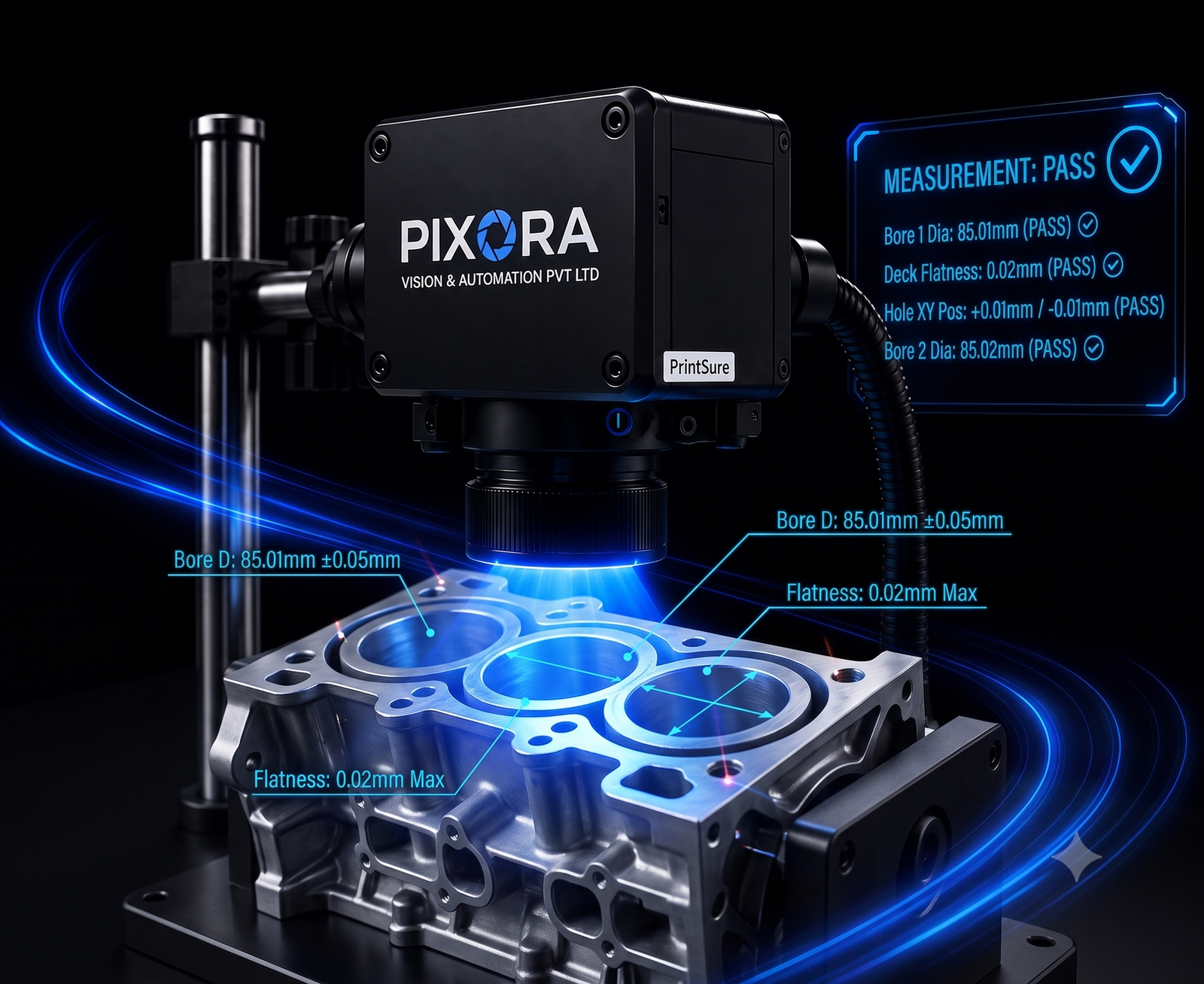
Confirms geometry against tolerance without touching the part.
Calibrated 2D imaging and 3D profiling measure features in-line, replacing gauges, calipers and offline CMM sampling. Because measurement happens on every unit rather than every hundredth, drift shows up as a trend you can correct — not as a rejected batch you discover later.
Telecentric optics and precision calibration for repeatability. Structured-light or laser triangulation where depth matters.
Machined component verification. Stamped and formed part checks. Connector and terminal pitch measurement. Bottle and container neck finish. Gasket and seal profile.
Non-contact measurement doesn’t wear, doesn’t mark delicate parts, and doesn’t slow the line down to do it.
Turns inspection results into decisions the line can act on.
Detection alone produces a pass/fail signal. Classification produces intelligence — what kind of defect, how severe, whether it’s rework or scrap, and whether the same defect is appearing more often than it did last week.
Grading in food and agricultural processing. Rework routing in electronics. Variant sorting on mixed-model assembly. Scrap classification in metal forming.
Knowing you rejected 127 units is a number. Knowing 83 were cracks from one specific station is a fix.

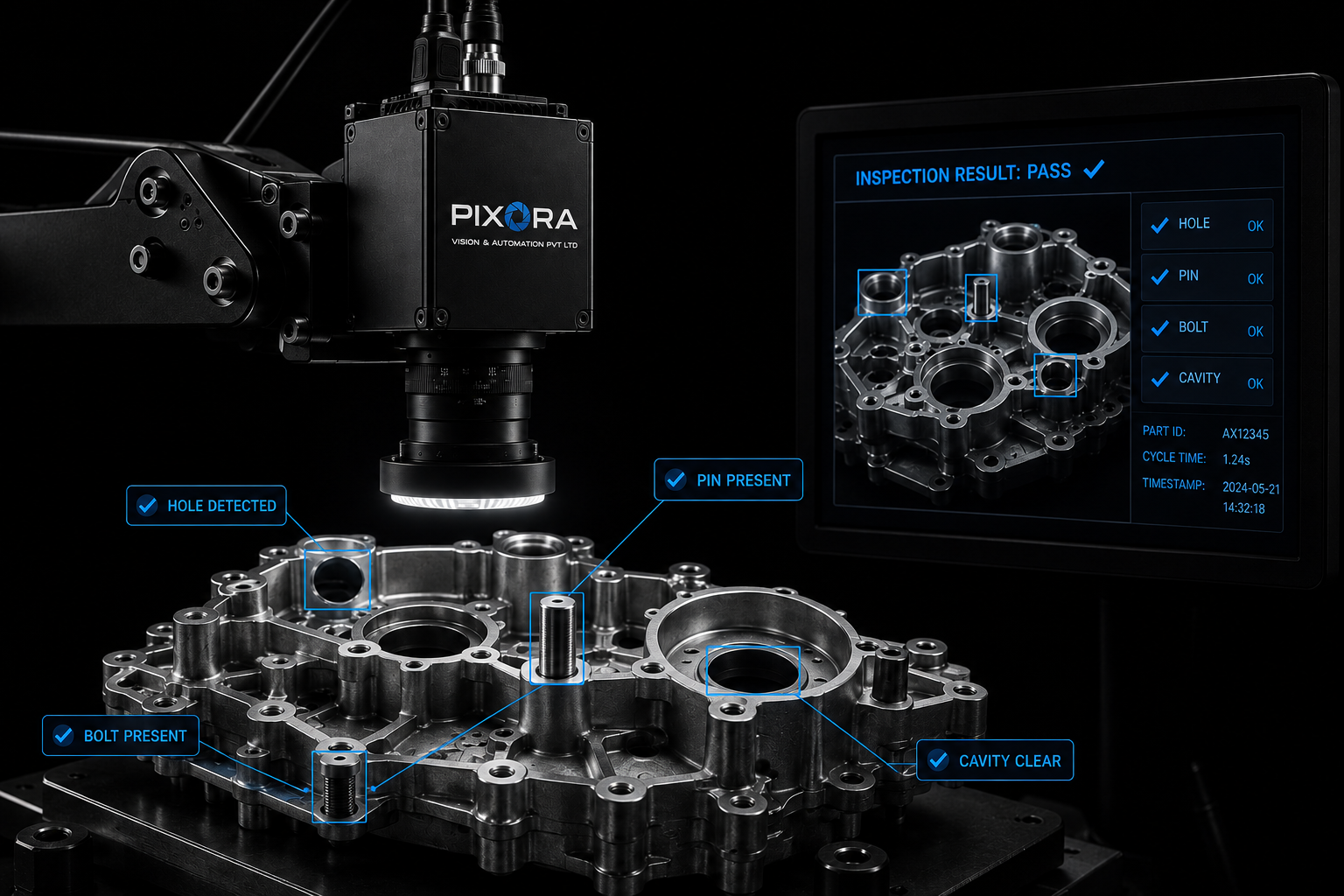
Confirms every part is present, correct, and in the right place — before the product moves on.
Most assembly failures aren’t subtle. They’re a missing clip, a reversed component, an unseated cap. They’re also the failures most likely to reach a customer, because there’s nothing visibly wrong with the rest of the unit.
PCB component population checks. Automotive sub-assembly verification. Pharmaceutical carton and leaflet confirmation. Bottling cap and seal presence. Kit and multipack completeness.
Catching a missing component at the station where it belongs costs a few seconds. Catching it after packing costs a recall.
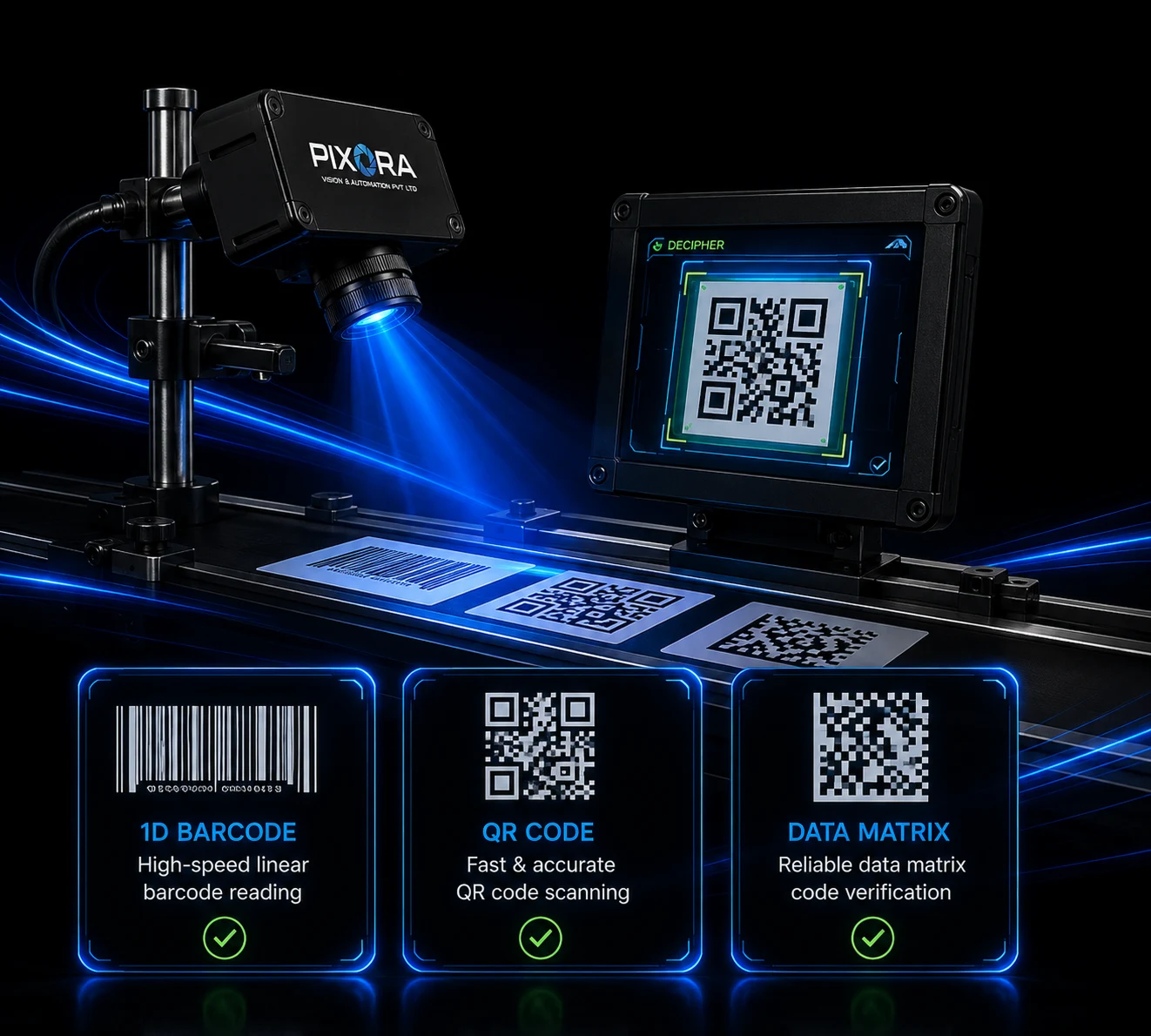
Reads and verifies everything printed, marked or labelled on the product.
Reading a code is the easy part. Verifying that the right code is on the right product, that it’s legible, and that the record survives an audit — that’s the actual requirement in regulated manufacturing.
Every read logged with image, timestamp and result — a traceable record per unit for compliance, recall scoping and root-cause analysis.
Pharma serialisation and track-and-trace. Food date-code verification. Automotive part traceability. Logistics sortation. Cosmetics and FMCG labelling.
An unreadable code downstream is a rejected shipment. Verify it at source.
Gives robots the ability to see what they’re handling — so they work with real-world variation instead of demanding it be eliminated.
Fixtured automation needs parts presented identically every time. That means jigs, feeders and changeover time. Vision guidance removes that constraint: the robot locates the part wherever it actually is.
Machine tending and load/unload. Packaging and case packing. Assembly insertion and fastening. Warehouse and line-side material handling.
Less tooling, faster changeover, and one cell that handles multiple SKUs instead of one cell per SKU.
End-to-end automation systems that orchestrate production, ensure compliance, and optimize operations — from smart mixing and filling to predictive maintenance and digital twins.
30–50%
Boosts output efficiency across every stage of production.
24/7
Runs reliably around the clock with minimal downtime.
Tracks every batch with complete, end-to-end visibility.
Built for the operation your process actually needs, not the one a catalogue machine was designed for.
Most plants have one or two stations that resist standard equipment — an odd part geometry, a non-standard cycle, a test nobody sells off the shelf. Those become the bottleneck the whole line runs at.
Concept and feasibility, mechanical and electrical design, fabrication, assembly, FAT, installation, commissioning and operator training.
Automotive component assembly. Pharmaceutical packaging lines. Electronics test and burn-in. FMCG filling and secondary packing.
A machine designed around your part runs at your cycle time. A machine you adapted to your part runs at whatever it will tolerate.
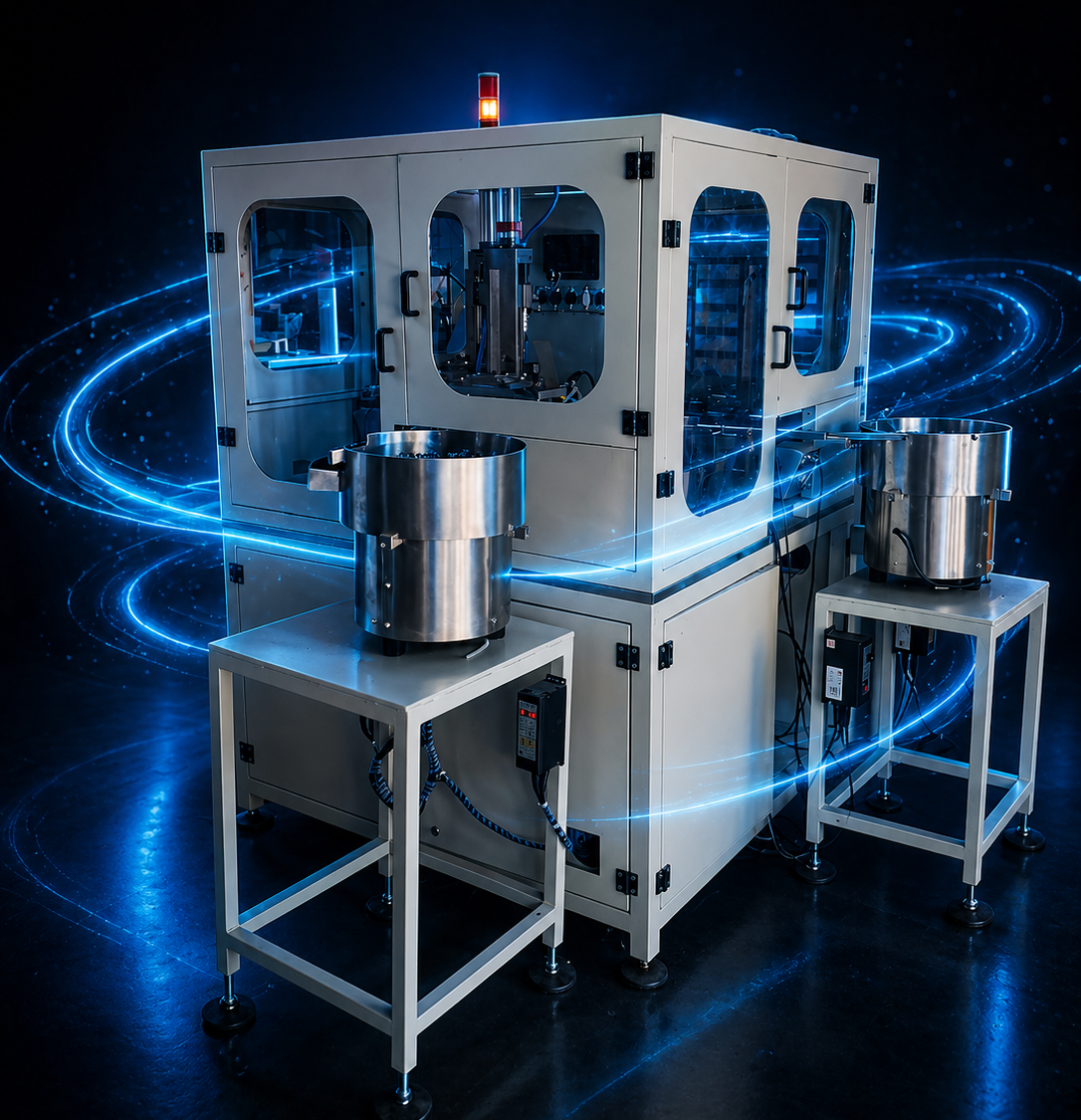
Connects the machines you already own into a line that behaves like one system.
Most plants don’t have an automation problem — they have an integration problem. Good machines running as islands, with manual transfer, buffers and handoffs between them absorbing the gains each machine was bought to deliver.
Layout design, line balancing, throughput modelling, integration with existing machine controls and interlocking across stations.
Packaging line linking. Machine-shop load and unload. Warehouse infeed and dispatch. Multi-station assembly lines.
Ten machines running independently is ten machines. Ten machines running together is a line.
The engineering layer everything else runs on — programmed, panelled and commissioned in-house.
Automation succeeds or fails at Level 1 and 2 of the stack. Sequencing, interlocking, fault recovery and safety logic determine whether a line runs a full shift or stops eleven times a day. This is where that work is done.
New machine builds, line retrofits, obsolete-control replacement, safety compliance upgrades.
Anyone can specify a PLC. The value is in logic that recovers cleanly from a fault instead of needing a manual reset.
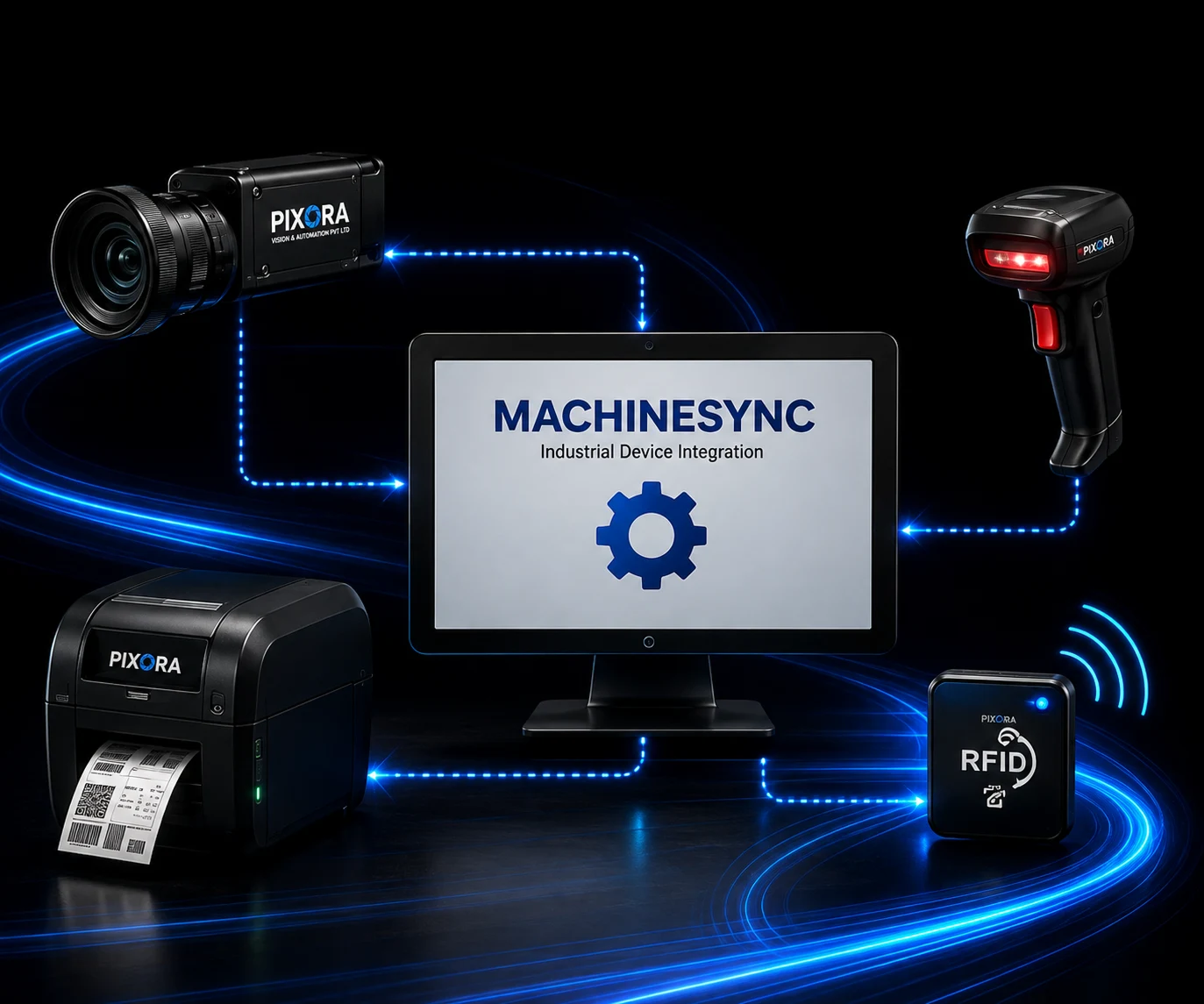
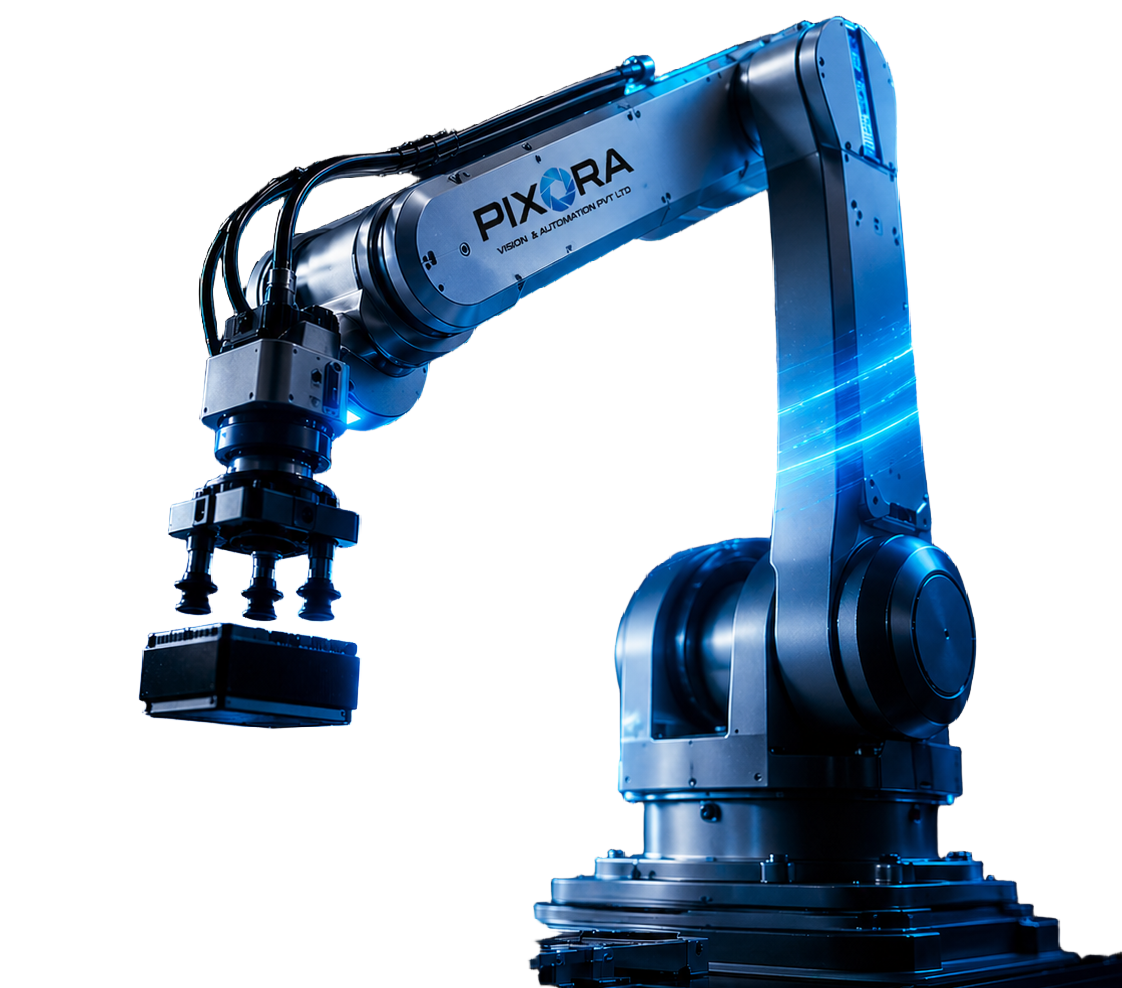
Robots deployed as working cells, not as equipment delivered to your floor.
A robot arm is roughly a third of a working robotic cell. The rest is tooling, fixturing, guarding, sequencing, safety validation and the vision that lets it handle real-world variation — and that’s the part most integrations underestimate.
Machine tending. Assembly and fastening. Palletising. Welding and dispensing. Material transfer between stations.
The robot is the commodity. The cell around it is the engineering.
Makes the line visible — and makes what happened on it provable.
Machine data exists whether or not you collect it. Most plants discover this only during a customer audit or a failure investigation, when the question is what happened on which shift, and nobody can answer with more than a logbook.
Pharma batch traceability. Food and beverage lot tracking. Automotive part genealogy. Multi-line OEE benchmarking.
“We think the second shift ran slower” is an opinion. A downtime report is a decision you can act on.

Turns the data layer into decisions made before the failure, not after it.
Preventive maintenance replaces parts on a calendar, whether they need it or not. Reactive maintenance replaces them after the line stops. Predictive maintenance replaces them when the machine’s own signals say they’re degrading.
High-utilisation continuous lines. Plants with expensive unplanned downtime. Multi-shift operations with thin maintenance cover.
Unplanned downtime costs more than the part that caused it — usually by an order of magnitude.

Industrial robots, cobots, and autonomous mobile systems that handle, assemble, sort, and transport — replacing manual labor in hazardous, repetitive, and precision-critical tasks.
Achieves ultra-accurate positioning for high-precision tasks.
Reduces manual effort while improving operational efficiency.
Accelerates production with significantly higher output rates.
Cobots work safely alongside humans for delicate tasks — wiring harness installation, lab sample handling, and small-batch personalized production.
AI navigation handles dynamic environments with 10,000+ units per hour throughput.
From flip-chip bonding at ±0.5μm to robotic piece-picking in logistics — accuracy meets speed.
Goods-to-person systems cut worker walking time by 90% while drone inventory scanning provides real-time stock visibility.
Eliminates human-borne contamination in semiconductor fabs, drug manufacturing, and medical device assembly.
Our systems are designed for high reliability, real-time performance, and seamless integration across manufacturing environments.
FAQs
AI-powered machine vision systems integrate deep learning models with your existing high-resolution cameras, PLCs, and robotics to deliver real-time, high-accuracy defect detection. Whether it’s surface flaws, incorrect assembly, or packaging errors, Pixora enables 24/7 automated quality control that reduces rework, recalls, and human error — all without replacing your current hardware.
Pixora brings AI-driven accuracy to logistics operations by verifying barcodes, checking labels, and inspecting kit/packaging integrity at speed. Our Visual Inspection systems ensure clean dispatches, reduce manual errors, and improve inventory record accuracy across warehouses and distribution centres.
Manual Inspection is slow, inconsistent, and prone to fatigue-based errors. Automated visual inspection systems offer 24/7 accuracy, higher throughput, and objective defect detection that never tires. Unlike traditional rule-based systems, Pixora’s AI adapts to product changes, delivers traceable insights, and supports continuous quality improvement – all while reducing cost and risk.
Yes. Modern AI Vision Inspection systems are built for flexibility – they adapt to new SKUs, product variants, packaging formats, and assembly types with minimal reconfiguration. Using just a few good samples, the system learns without manual programming, enabling fast changes and accurate inspection across high-mix production or packaging lines.
Visual Inspection systems are edge-deployed for real-time, in-line and end-of-line inspection without delays. Our pre-configured pipelines and domain-optimized AI plug into your existing setup, including MES/ERP systems, ensuring quality control with zero disruption.
Let's Get Started
Schedule a personalized demo to see how Pixora can transform your quality inspection process.